








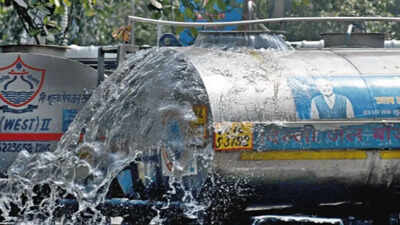
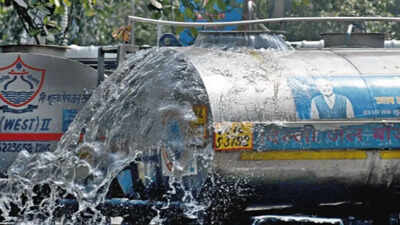
NEW DELHI: In the midday sun, a stream of water gushes into a Delhi Jal Board (DJB) tanker at the Gulabi Bagh filling point. The excess water spills onto the ground and pools around the facility. Waterlogged roads, muddy patches and standing puddles surround the station as tanker after tanker queues up for refilling. Wastage starts even before tankers begin their journey.Tankers arrive at the facility at intervals of roughly five minutes, underscoring the high demand as well as the scale at which such losses accumulate throughout the day.Children bathe in a ‘shower’ of water falling from a pipeline that the staff has seemingly forgotten to turn off. As the tankers prepare to move out one after another, water leaks from valves, joints and overflow points.TOI follows tanker number DL 1 MA 0984 on its journey to Nehru Nagar, near West Patel Nagar. During the 25-minute drive, the tanker passes six traffic signals, spilling hundreds of litres of water along the way.The water is meant for around 200 households in lanes 3, 6 and 7 in Nehru Nagar, where residents have already queued up, hoses and cans at the ready.As the tanker accelerates through traffic, the spillage intensifies. Water streams out of the vehicle’s rear and sprays onto the road, leaving a visible trail. At traffic signals and road bends, water gushes out of the top.Vehicle age, wear & tear of tanker accessories, poor roads and speed breakers cited as reasons for leakageWe have seen this wastage for years. Before reaching the destination, many, many buckets of water are lost, while people fight for a single pail. Nothing has changed,” a bike rider tells TOI at a traffic intersection.At some places, the water mixes with dirt and debris, turning stretches of road into slush. Motorcyclists and pedestrians navigate around these patches while cars splash through.Speaking to TOI , the tanker driver says he makes six to seven trips a day. Leakages occur due to multiple reasons, including age of the vehicle, poor road conditions, speed breakers and wear– and tear of tanker accessories, he says.But why are lids on tankers open? The answer lies in fluid dynamics. When water in a closed container is agitated, as it is when a tanker moves, it creates a sloshing effect. This destabilises the vehicle and can cause it to topple, especially at traffic signals and sharp turns.There are proven solutions to this problem. Internal partitions with small holes, called baffles, are built into tankers to help dissipate the effect of sloshing. Such baffles are commonly found in tankers transporting milk and oil. While DJB has bought some tankers with baffles, most are old and do not have the technology.The tanker eventually reaches its destination around 12.30pm. The houses here are part of DJB’s piped network but regular supply stopped a year and a half ago, residents claim.Says Phulo Devi, a 45year-old resident, “We somehow manage with two or three buckets of water a day. People avoid talking to each other because if someone gets less water or misses out, fights break out. Everyone needs water, and a person cannot survive on two buckets. Here, a family of five has to make do with just this much. We are forced to buy water.”A senior DJB official says more than 1,000 water tankers have been deployed across Delhi to ensure uninterrupted water supply. There are 25 filling points across the city. On average, approximately 6,400 tanker trips are undertaken daily, particularly to waterstressed areas. Continuous monitoring and coordination is carried out to maximise coverage, he adds.Minister Parvesh Verma, who is also the DJB chairperson, says wastage will be addressed. “We will inspect all filling points to identify and stop leakages. If needed, CCTV cameras will also be installed. We will figure out how to reduce such wastage in the entire process, as water is very valuable for us,” he says.