







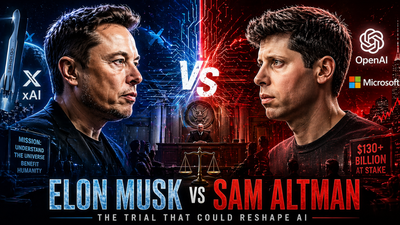
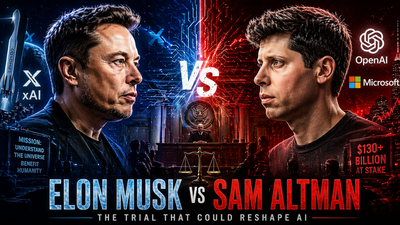
One of the most consequential legal battles in the history of artificial intelligence is now playing out in a federal courtroom in Oakland, California. Elon Musk, the world’s richest person and CEO of Tesla, SpaceX, and xAI, is suing Sam Altman, the CEO of OpenAI, along with OpenAI president Greg Brockman and Microsoft, alleging a fundamental betrayal of the organisation’s founding mission. The trial, which began with jury selection on April 27, 2026, is expected to last four weeks and could reshape the future of one of the world’s most valuable AI companies and the broader industry along with it.
How Musk-Altman clash began: A shared vision that fell apart
Musk and Altman co-founded OpenAI together in 2015, alongside other researchers and technologists, with an explicit mission: to develop artificial intelligence safely and for the benefit of humanity as a nonprofit. Musk contributed significant funding in the early years and served on the board. In 2018, however, he departed following what multiple accounts describe as an internal power struggle. Musk wanted greater operational control; OpenAI’s other founders disagreed. He has not been involved with OpenAI since.In 2023, Musk filed a lawsuit accusing Altman, Brockman, and others of deceiving him and the public by abandoning OpenAI’s nonprofit structure when the company began operating a for-profit subsidiary. He argues that the transformation enriched Altman, Brockman, and investors, particularly Microsoft, which has poured billions into the company, at the expense of the charitable mission Musk says he was promised.
Elon Musk’s core claims
At the heart of Musk’s case are two remaining legal claims: unjust enrichment and breach of charitable trust. Of the 26 original claims filed in 2024, all but two were either dismissed by the court or dropped by Musk’s own legal team ahead of trial in an effort to streamline the case.Musk pledged $1 billion to OpenAI when it was founded in 2015, though OpenAI says he contributed roughly $45 million before leaving in 2018. He claims he supported the organisation on the understanding that it would remain a nonprofit focused on benefiting humanity. The later shift to a for-profit structure, backed by investors including Microsoft, generated substantial value that he argues diverged entirely from that original purpose. He is seeking more than $134 billion in damages, with the stipulation that any awarded funds go to OpenAI’s nonprofit arm rather than to himself personally. He is also asking the court to remove Altman and Brockman from their leadership roles and to restore OpenAI to a nonprofit structure.
OpenAI and Altman’s counterclaims
OpenAI has consistently rejected Musk’s lawsuit, calling it “a baseless and jealous bid to derail a competitor.” Altman and his co-defendants offer a starkly different version of events. According to OpenAI, Musk himself advocated for a for-profit model in the early days and even pushed for OpenAI to be folded into Tesla. They contend that he left the organisation in 2018 not because of principled disagreement but because he was unable to take sole control. On the question of the restructuring, OpenAI argues it was a business necessity, as without the ability to raise commercial capital, the company could not have competed in an extraordinarily expensive AI race. The nonprofit, they say, retains a 26% stake in the for-profit entity and continues to guide the organisation’s safety mission.
A star-studded witness list
The trial is expected to draw some of the most prominent figures in global technology to the witness stand. Both Musk and Altman are expected to testify, as is Microsoft CEO Satya Nadella and various current and former OpenAI board members and senior researchers. The witness list has been described as a virtual who’s who of Silicon Valley, making jury selection a particularly delicate exercise. A much larger pool of candidates, roughly three times the typical number for a civil case, was called during selection given the extraordinary public profile of the principals involved.
Legal questions at the centre of the case
Beyond the personal drama, legal experts have raised substantive questions about the case itself. Some nonprofit law scholars are puzzled that the judge allowed Musk to bring a breach of charitable trust claim at all, noting that typically such claims are brought by the relevant state attorneys general, not by former donors or board members. The attorneys general of both California and Delaware struck a separate agreement with OpenAI in October 2025 approving the restructuring under certain conditions, and California’s attorney general has declined to join Musk’s lawsuit, stating the office did not see how his action serves the public interest. Legal experts have also noted that the case is being argued under trust law, which some believe is an imperfect framework for evaluating the actions of a complex technology organisation.
What’s at stake
The consequences of this trial extend far beyond two feuding billionaires. OpenAI is preparing for a highly anticipated initial public offering, and a ruling in Musk’s favour could throw those plans into disarray, potentially forcing a structural overhaul and the removal of Altman and Brockman from leadership. OpenAI and its for-profit arm are currently valued at more than $300 billion on private markets. For Musk, a victory would hand his own AI company, xAI, which he merged with SpaceX earlier in 2026, a significant competitive advantage by destabilising its most formidable rival. Critics have pointed out that this potential benefit makes his stated altruistic motives harder to assess at face value. Whatever the verdict, the four-week trial will almost certainly produce revelations through testimony, texts, and emails that illuminate how today’s most powerful AI company was built, and the personal and financial tensions that shaped it.