








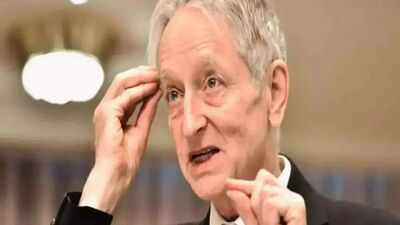
For generations, consciousness has been viewed as one of the defining traits that separates humans from machines. While artificial intelligence has grown increasingly capable of writing, reasoning and solving complex problems, most people still assume that genuine experience remains uniquely human. That assumption is now being challenged by one of the field’s most influential pioneers. Geoffrey Hinton, often called the “Godfather of AI” for his groundbreaking contributions to machine learning, believes advanced chatbots may possess a form of subjective experience. His remarks have reignited a long-running debate that extends far beyond computer science into philosophy, neuroscience and psychology. As AI systems become more sophisticated, researchers are increasingly confronting a difficult question: if machines can think, learn and reflect, could they also be conscious?
‘Godfather of AI’ Geoffrey Hinton believes chatbots may possess consciousness
For decades, consciousness has occupied a peculiar position in science. Memory can be studied. Attention can be measured. Decision-making can be mapped through neural activity. Yet the question of subjective experience: what it feels like to perceive, think or exist remains far more difficult to explain. Geoffrey Hinton argues that people often treat these experiences as mysterious entities separate from the brain itself, but he believes that view is misleading. According to Hinton, advanced chatbots may already possess a form of subjective experience, raising the possibility that consciousness is not limited to humans.“I think it’s going to get much more intelligent than us — that’s my guess,” Hinton said.This line of thinking places advanced chatbots in unfamiliar territory. Systems equipped with cameras, memory and sophisticated reasoning can already describe what they perceive, explain mistakes and revise earlier interpretations. For Hinton, such abilities suggest that the gap between human and machine consciousness may be smaller than many people assume.
Unresolved challenge of consciousness in philosophy and cognitive science
Not everyone agrees that the leap from representation to experience is justified. Many philosophers and cognitive scientists argue that describing information processing does not answer the deeper question of why any of it should feel like something from the inside. A machine may identify the colour red, explain how lighting conditions altered its judgement, and adjust its answer. But does it actually experience redness? Or is it merely processing data according to rules and probabilities? “I think we’ve got a new revolution coming, when we’re not the only beings around,” he said. Critics of Hinton’s view argue that this first-person quality cannot simply be replaced by descriptions of information flow, however sophisticated those descriptions become.
Consciousness and the limits of experimental science across disciplines
Part of the difficulty is that consciousness resists the methods that transformed other scientific fields. Astronomers can observe distant galaxies. Chemists can isolate compounds and repeat experiments. Consciousness is different. Each person has direct access only to their own experience. Everything else must be inferred through behaviour, language or brain activity.That limitation has produced competing theories rather than consensus. Some researchers believe consciousness emerges from complex information processing. Others suspect it depends on particular biological mechanisms found only in living brains. A third group argues that entirely new concepts may be needed before the mystery can be addressed properly.Hinton argued that the solution is less like engineering a machine and more like raising a child. Intelligence alone, he suggested, does not naturally produce good behaviour. It has to be shaped, guided, and carefully cultivated from the start.On training data, he added: “Would you teach your child to read from the diaries of serial killers? Probably not. There you go. That’s your answer.”