









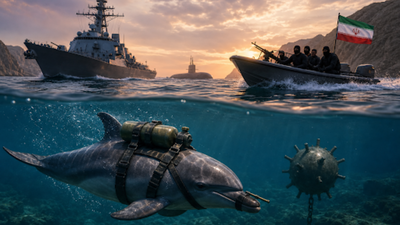
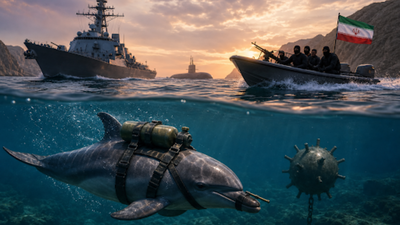
Iran is reportedly considering the use of dolphins trained to carry mines as part of potential attacks on US warships in the Strait of Hormuz, highlighting an unusual and controversial tactic amid rising tensions in the region.The idea has emerged as pressure grows inside Iran following a financially damaging blockade that has restricted its oil exports for weeks. While a fragile cease-fire with the United States remains in place, some Iranian hardliners increasingly view the situation as an act of war and are calling for renewed military action.According to a report by The Wall Street Journal, officials say that action could involve deploying dolphins equipped with mines to strike enemy vessels. The approach reflects a broader push to consider previously unused weapons as the economic crisis deepens.This would not be the first time Iran has explored the use of military-trained dolphins. The country acquired such animals from the Soviet navy in 2000, according to BBC. At the time, they were described as being trained to attack targets using harpoons attached to their backs and to carry out missions involving explosives, including potential kamikaze-style strikes against enemy ships.“The blockade is increasingly viewed in Tehran not as a substitute for war, but as a different manifestation of it,” Hamidreza Azizi, a visiting fellow specializing in the Middle East at SWP, a Berlin-based research institute, told WSJ. “As a result, Iranian decision makers may soon come to see renewed conflict as less costly than continuing to endure a prolonged blockade.”Alongside the reported dolphin strategy, Iran could also deploy submarines in the waterway. The Islamic Revolutionary Guard Corps has additionally threatened to cut key phone cables running through the strait, a move that could disrupt global internet communications and escalate tensions further.
Mine threat and shipping concerns
For shippers considering whether to cross the Strait of Hormuz, the risk of attacks above water remains the main deterrent rather than undersea mines. US officials have made contradictory comments about the number of mines and the level of risk they pose. Donald Trump has ordered the US Navy to “shoot and kill” any Iranian boat laying mines in the strait.While the military remains concerned about Iran’s ability to mine the crucial waterway, officials have so far said mines are more of a nuisance than a major threat to shipping. Still, analysts say clearing mines is necessary for vessels to resume using the central route through the strait instead of slower and more congested Iranian routes.The U.S. Navy maintains a range of options for mine detection and removal, including helicopters, littoral combat ships, sea drones and even trained dolphins as part of its marine mammals program. It also deploys sea drones to locate mines.Defense companies and navies, including those in the US, are experimenting with unmanned systems and artificial intelligence to improve minesweeping. However, these technologies remain limited in number and are largely untested in active conflict.
How minesweeping works
Minesweeping operations typically begin with scanning. The Common Uncrewed Surface Vessel, a drone made by RTX Corporation, tows a sonar system known as the AQS-20 to scan sections of the seabed about 100 feet wide at a time.Battery-powered submarine drones, including the MK18 Mod 2 Kingfish and the Knifefish developed by General Dynamics, can be deployed from small boats to scan the seabed in patterns.Once mines are identified, a second wave of sea robots can be sent to neutralize them, either by triggering them remotely or destroying them with explosives. Military analysts say an initial scan of the relatively narrow strait could be completed quickly, followed by targeted efforts to remove any detected mines.