











A thermal image allegedly showing a new aircraft over Area 51 has sparked speculation about the US Air Force’s sixth‑generation stealth fighter, the Boeing F‑47. The outline of the aircraft resembles that of the F‑47 demonstrator, two renditions of which were released in the White House last year. The Next Generation Air Dominance (NGAD) program, launched by President Trump, represents the US Air Force’s next generation of fighters. The US Navy is pursuing its own F/A‑XX sixth‑generation project. Boeing has started production of the first F-47 sixth-generation stealth fighter, US based The War Zone had reported in September last year. Although a prototype of the aircraft has been flying since 2020 according to the US Air Force.Globally, sixth‑generation fighter development is accelerating. China is already testing two prototypes, while Europe is advancing two collaborative programs: the Franco‑German‑Spanish Future Combat Air System (FCAS) and the UK‑Japan‑Italy Global Combat Air Programme (GCAP). Airbus expects the FCAS prototype to fly in 2028, while GCAP is expected to have its first flight next year. Neither of these European aircraft are expected to enter frontline service before the mid‑2030s. India, meanwhile, is exploring partnerships rather than starting from scratch. Air Chief Marshal AP Singh has confirmed the Indian Air Force’s interest in joining one of these international programs, with deliberations ongoing at the Parliamentary Committee on Defence.
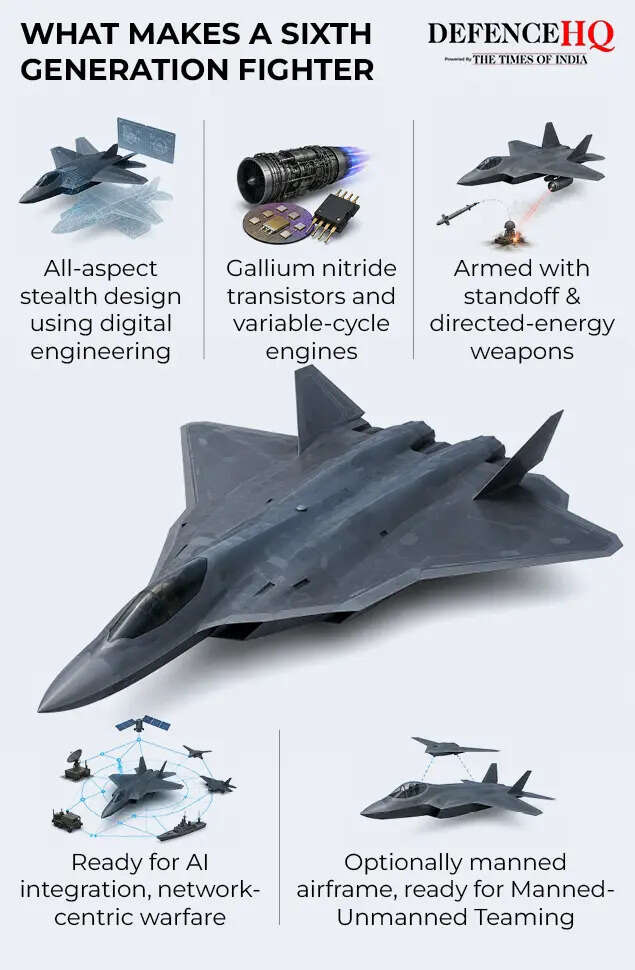
Technologically, sixth‑generation fighters mark a decisive break from fifth‑generation designs. Instead of frontal stealth, these aircraft since under developnment feature all‑aspect stealth shaping. Built using digital‑first engineering and model‑based design, their software architecture isolates flight‑critical functions for resilience. Gallium nitride transistors and variable‑cycle engines deliver both efficiency and high thrust. Weapons suites of the sixth-generation aircraft will include long‑range standoff missiles and potential directed‑energy defenses.Artificial intelligence, advanced networking, cyber warfare tools and battlefield command‑and‑control systems accelerate decision‑making. Human‑systems integration is enhanced through helmet‑mounted virtual cockpits offering 360‑degree vision and AI‑augmented awareness. These fighters are also expected to operate in a manned-unmanned teaming configuration, in which the manned plane will control one or more loyal wingmen which will improve the effectiveness of these next generation combat aircraft.In sum, the Area 51 sighting underscores the rapid evolution of sixth‑generation combat aircraft. With the U.S., China, Europe, and India all pursuing programs, the next decade will define the future of airpower, blending stealth, digital engineering, AI, and multi‑domain integration into platforms designed for dominance well into the mid‑21st century.