









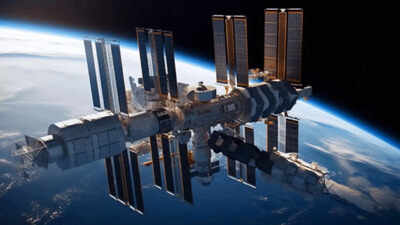
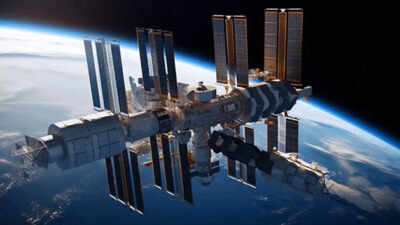
India’s aspirations in space exploration are taking a major leap forward as it develops the Bharatiya Antriksh Station. The project, which seems to be heavily connected to the Gaganyaan mission, is now going beyond the conceptual phase. According to PIB reports, the space station will have five modules, of which the first module, called BAS-01, is said to be launched by 2028. The government has approved the first module of the space station, defining its budget as well as timeline. India is not only aiming to place its flag in space but is also looking forward to establishing an innovation hub in space.
ISRO ’s Bharatiya Antriksh Station: First module BAS-01, timeline and budget
The Bharatiya Antriksh Station is reportedly designed as a multi-module orbital facility. ISRO has finalised the overall configuration, which has already been reviewed at the national level. The first module, BAS-01, will serve as the foundation. Current approvals cover only this module, though the full five-module station is targeted to be operational by 2035, as reported.According to PIB, the development and launch of the first module has an estimated cost of Rs 1763 crore. This budget covers the period from 2025 to 2028. Experts reportedly see this phased funding as a way to manage financial and technical risks. The 2028 target for BAS-01 also seems aligned with India’s broader human spaceflight objectives. While the total project will extend to 2035, initial success with BAS-01 will provide insights that could shape subsequent modules.
BAS-01 to use advanced technology with private help
Early signs indicate that Indian industries might play a role in building the station. The Vikram Sarabhai Space Centre has issued an Expression of Interest for private companies to help realise the structure of BAS-01. This reportedly marks a shift in India’s space programme, which has traditionally been government-led. Involving industry might speed up development and spread technical knowledge more widely. Experts suggest that collaboration with private firms could also reduce costs and bring in specialised expertise, a model increasingly seen in other countries’ space programmes.The station will reportedly focus on several advanced technologies. Rendezvous and docking capabilities are planned, which are crucial for connecting modules and managing future crewed missions. Robotics will assist in maintenance and operations, while in-orbit refuelling might allow longer mission durations. Crew quarters and intra-vehicular suits are also being designed to ensure astronauts can work comfortably and safely. BAS is expected to include racks for microgravity experiments.
Microgravity research to unlock new insights for science and industry
Microgravity research seems to be a key objective. Life sciences, pharmaceuticals, material sciences, and manufacturing technologies are all likely to benefit. Experts say that experiments in zero-gravity conditions can reveal processes that are difficult or impossible to observe on Earth.