









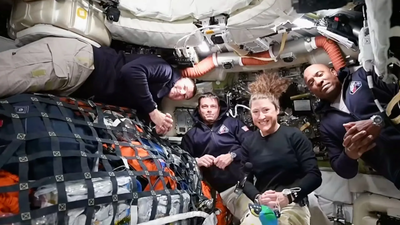
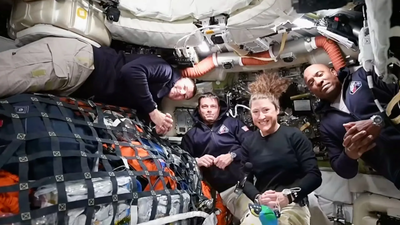
Nasa’s Artemis 2 astronauts made history on Monday, April 6, becoming the first humans in more than 50 years to fly around the moon and breaking the Apollo 13 record for the farthest human spaceflight.The Artemis II crew has begun seven hours of lunar observation, capturing images of the Moon’s near and far sides while describing their views in real time. The four-member crew- commander Reid Wiseman, pilot Victor Glover, and mission specialists Christina Koch and Jeremy Hansen-surpassed 248,655 miles from Earth, setting a new record on their lunar flyby. The seven-hour mission has already provided the astronauts with breathtaking views of the moon and Earth, marking a major milestone for Nasa and human spaceflight. Artemis 2 is the first crewed mission to travel to the moon since Apollo 17 in 1972, and the first of the 21st century to venture so far from Earth. As Orion approached the moon over the past few days, the crew began taking in striking views of Earth’s closest neighbor. “The four of us have looked at the moon our entire lives, and the way we are responding to what we’re seeing out the window is just like we’re a bunch of kids up here,” Artemis 2 commander Reid Wiseman radioed to Mission Control. “We cannot get enough of this. It’s amazing.”The astronauts are expected to see parts of the moon that Apollo crews were never able to view up close, including the poles of the far side. They are also set to witness a rare solar eclipse from beyond the moon.Nasa says the flyby will also support future Artemis missions. Although the astronauts will not land on the lunar surface, they will spend the flyby observing the moon and gathering information that could help later missions.Artemis 2 lunar science lead Kelsey Young said Nasa has planned 10 science objectives and 35 different targets for the crew during the flyby.The astronauts will work in two-person shifts over five hours of the main flyby period. Using a tablet-based Lunar Targeting Plan app, they will record voice observations while taking potentially thousands of photos of lunar craters, plains and mountains.The Orion spacecraft is currently on a looping path that will carry it around the far side of the moon and back again. Nasa says the spacecraft has now entered the moon’s “lunar sphere of influence,” where the moon’s gravitational pull has more effect on Orion than Earth’s.
Artemis 2 moon flyby timeline (EDT / IST)
Monday, April 6
- 1.30 pm EDT / 11.00 pm IST — The science officer in the Mission Control Center at NASA’s Johnson Space Center in Houston will brief the crew on their science goals for the upcoming flyby.
- 1.56 pm EDT / 11.26 pm IST — The Artemis II crew is expected to surpass the record previously set by the Apollo 13 crew in 1970 for the farthest humans have ever traveled from Earth.
- 2.45 pm EDT / 12.15 a.m. IST (April 7) — Lunar observations begin.
- 6.44 pm EDT / 4.14 a.m. IST (April 7) — Mission control expects to temporarily lose communication with the crew as the Orion spacecraft passes behind the moon.
- 6.45 pm EDT / 4.15 a.m. IST (April 7) — During “Earthset,” Earth will glide behind the moon from Orion’s perspective.
- 7.02 pm EDT / 4.32 a.m. IST (April 7) — Orion reaches its closest approach to the moon at 4,070 miles above the surface.
- 7.07 pm EDT / 4.37 a.m. IST (April 7) — The crew reaches its maximum distance from Earth during the mission at 252,706 miles.
- 7.25 pm EDT / 4.55 a.m. IST (April 7) — “Earthrise” marks Earth coming back into view on the opposite edge of the moon.
- 7.25 pm EDT / 4.55 a.m. IST (April 7) — Mission control will re-acquire communication with the astronauts.
- 8.35 pm to 9.32 pm EDT / 6.05 a.m. to 7.02 a.m. IST (April 7) — During a solar eclipse, the sun will pass behind the moon from the crew’s perspective.
- 9.20 pm EDT / 6.50 a.m. IST (April 7) — Lunar observations conclude.
Tuesday, April 7
- 1.25 pm EDT / 10.55 pm IST — Orion exits the lunar sphere of influence at 41,072 miles from the moon.