








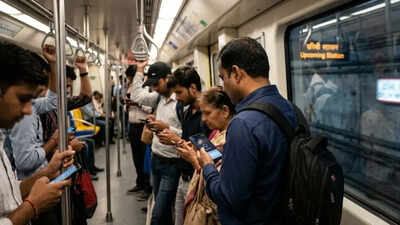
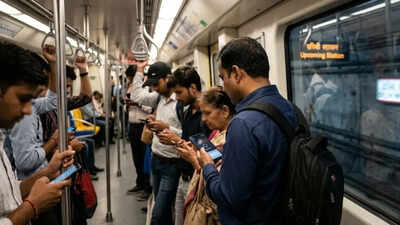
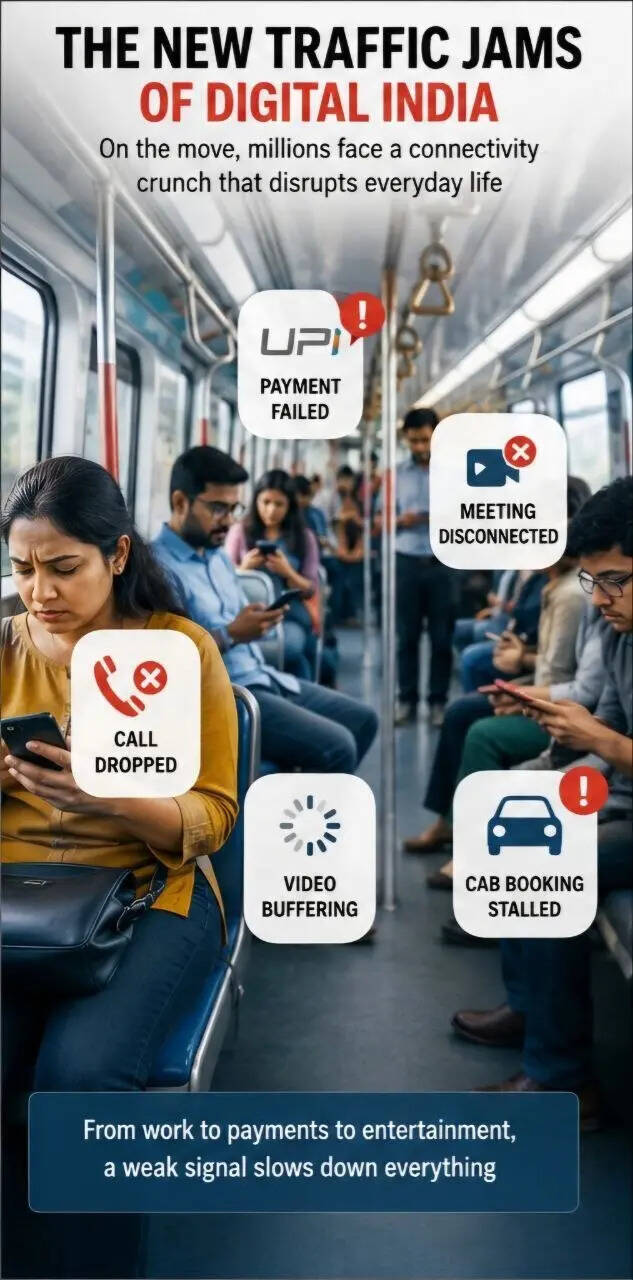
Uninterrupted connectivity is becoming as essential to urban mobility as trains and roads as work, payments and entertainment move online. The modern Indian city commuter carries more than a smartphone. He carries his office, his bank account, his entertainment, his travel tickets and increasingly, his daily life in that device.Yet, a fresh Telecom Regulatory Authority of India (TRAI) assessment of mobile services across Delhi-NCR’s Metro and Namo Bharat corridors shows that staying connected while travelling remains far from guaranteed.TRAI’s independent drive tests, conducted across nearly 490 km of metro and rapid rail routes, found significant differences in network performance among telecom operators. While Reliance Jio emerged as the fastest on downloads and Airtel topped uploads, the larger story is that even in India’s capital region, seamless connectivity during travel remains a challenge.For millions of commuters, this is not merely about call drops anymore. It is about interrupted office meetings, failed UPI transactions, buffering videos and delayed communication during daily journeys.The metro coach has become an officeThe findings come at a time when commuting patterns have fundamentally changed.A decade ago, most passengers used their travel time for phone calls, music or messaging. Today, Metro coaches are filled with people attending virtual meetings, uploading presentations, making digital payments, trading stocks, booking cabs and consuming large volumes of video content.The average Indian mobile user now consumes some of the highest volumes of data globally. Much of that usage happens while travelling.This has transformed connectivity from a convenience into a basic urban utility.A commuter travelling from Dwarka to Noida or Ghaziabad may spend more than an hour on public transport. For many professionals, that time is no longer idle. It is productive work time. Every signal interruption therefore carries a cost.
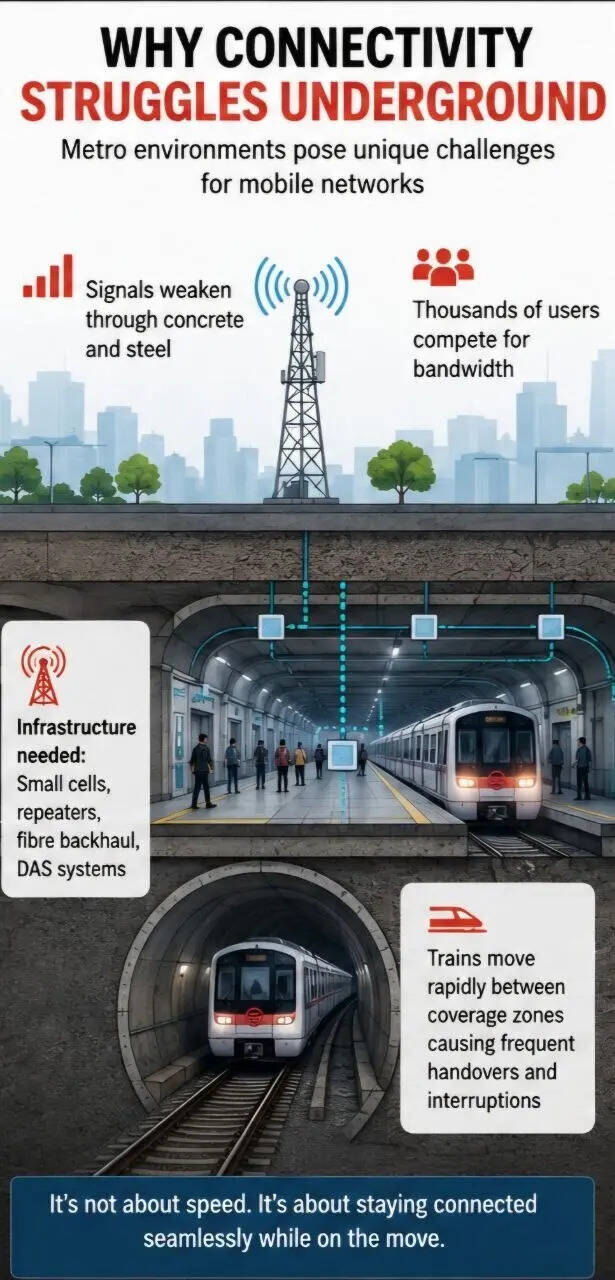
Why connectivity remains difficult undergroundThe common perception is that 5G rollout should have solved most connectivity problems. The reality is more complicated.Mobile networks perform best in open environments where signals can travel freely between towers and devices. Metro systems, especially underground sections, create the exact opposite conditions.Concrete walls, steel structures, tunnels and enclosed stations weaken radio signals. To overcome these obstacles, operators must install dedicated telecom infrastructure throughout the transit network.This includes fibre backhaul, distributed antenna systems, repeaters and small cells that boost coverage in limited areas.The challenge becomes even greater as passenger data consumption rises.Infrastructure designed years ago for voice calls and basic internet usage is now expected to support thousands of simultaneous video streams, cloud applications and high-definition content. Even a well-designed network can come under pressure.The challenge of a moving userUnlike a person sitting in an office, a commuter is constantly moving between network zones.As trains travel through tunnels, elevated tracks, commercial districts and residential areas, phones continuously switch from one cell site to another.These transitions, known as handovers, are among the most complex functions in mobile networking.Every handover carries the risk of interruption.The challenge becomes even greater on high-speed systems such as the Namo Bharat Regional Rapid Transit System, where trains move significantly faster than conventional metro services.Maintaining uninterrupted connectivity at such speeds requires extensive coordination between telecom operators and transport authorities.
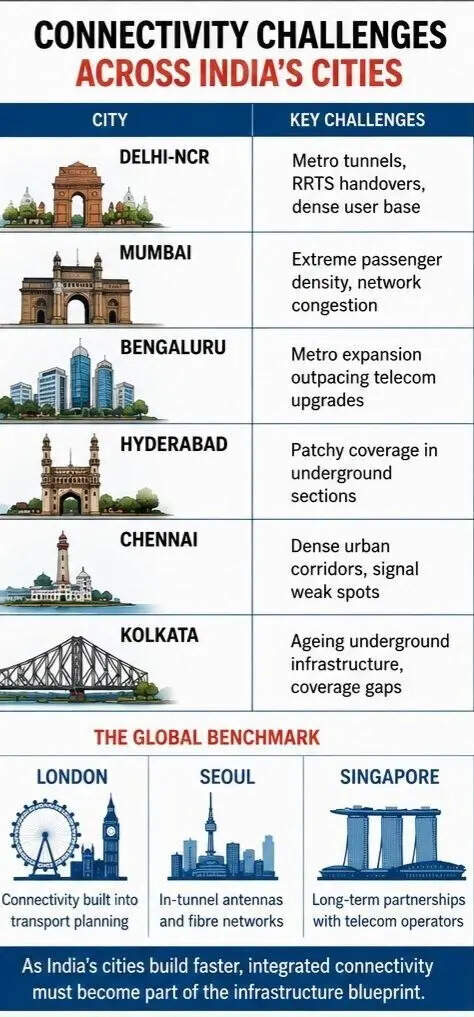
Delhi is not aloneThe issue extends well beyond the national capital.Mumbai’s suburban railway system, among the busiest in the world, routinely faces complaints of network congestion during peak hours. Large passenger concentrations at stations and inside coaches often strain available capacity.Bengaluru’s expanding Metro network presents another challenge. New corridors frequently open faster than telecom infrastructure can be upgraded, leading to patchy connectivity in some stretches.Hyderabad, Chennai and Kolkata have also witnessed periodic complaints about weak signals in underground sections and densely built urban corridors.The problem is therefore not unique to any one city. It reflects the broader challenge of integrating telecom infrastructure into rapidly expanding transport networks.Digital payments raise the stakesPerhaps the biggest difference between today’s commuters and those of a decade ago is the dependence on digital payments.India processes billions of UPI transactions every month. A growing share of these transactions takes place while people are travelling.Network disruptions can delay ticket purchases, food deliveries, cab bookings and other routine activities.As cities become increasingly digital, reliable mobile connectivity is assuming the same importance as electricity, water supply and public transport.Urban planners traditionally focused on roads, rail systems and utilities. Mobile connectivity was often treated as a separate concern.That distinction is becoming harder to maintain.
Why small cells are becoming criticalOne of the lessons from global cities is that traditional telecom towers alone cannot solve urban connectivity problems.Instead, operators increasingly rely on dense networks of small cells — compact radio units installed on poles, pillars, stations and other structures.Delhi Metro has already deployed such systems in several locations, particularly along stretches where conventional tower coverage is difficult.Small cells provide targeted coverage and help maintain service continuity in areas with heavy passenger movement.Industry experts believe future urban networks will depend less on large towers and more on thousands of interconnected small installations.The global benchmarkCities such as London, Seoul and Singapore increasingly treat mobile connectivity as part of transport infrastructure rather than an afterthought.Telecom planning is integrated into transit projects from the design stage itself.Dedicated fibre networks, in-tunnel antennas and long-term partnerships with telecom operators are incorporated into expansion plans.India’s rapidly growing metro and rapid rail systems may eventually need a similar approach.More than a telecom issueThe TRAI report offers a snapshot of network performance across Delhi-NCR’s transport corridors. But it also highlights a broader reality.The debate is no longer about whether Indian cities have mobile coverage. Most do.The challenge now is whether that coverage remains seamless when millions of people are moving through tunnels, stations, elevated corridors and high-speed transit systems every day.As urban India becomes increasingly digital, uninterrupted connectivity is emerging as a key measure of quality of life.For commuters, the next stage of urban infrastructure may not be another Metro line or expressway. It may simply be the ability to complete a phone call, join a video meeting or make a payment without losing signal midway through the journey.