







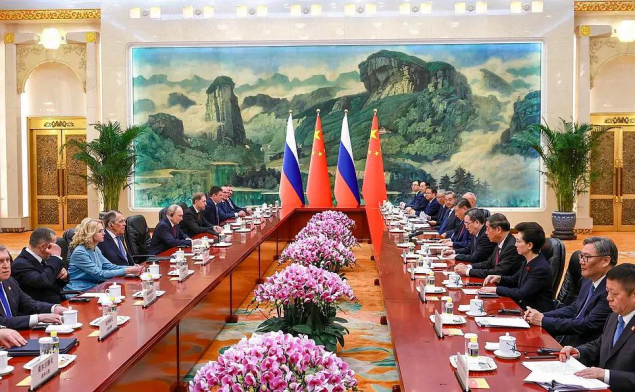
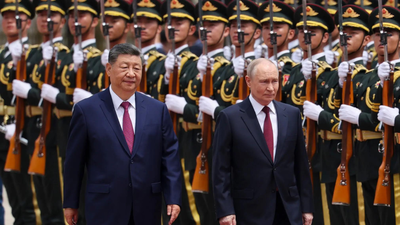
Just days after US President Donald Trump concluded his high-profile visit to Beijing, Chinese President Xi Jinping rolled out another elaborate welcome at the Great Hall of the People, this time for Russian President Vladimir Putin.The meeting came amid rising geopolitical tensions, including the ongoing war in Ukraine, war in the Middle East and growing rivalry between Washington, Moscow and Beijing. Both Xi and Putin repeatedly described their ties as stronger than ever, while taking veiled swipes at the United States and presenting themselves as defenders of a multipolar world order.
A carefully staged show of unity after Trump ’s visit
One of the clearest messages from the summit was symbolic rather than economic. By hosting both Trump and Putin within the span of a week, Xi reinforced China’s growing diplomatic weight and its ability to engage rival global powers on its own terms.Putin described bilateral ties as being at an “unprecedentedly high level”, while Xi called the relationship “unyielding” and built on deep strategic trust. The two leaders repeatedly addressed each other as “dear friend”, continuing a pattern that has defined their relationship for more than a decade.
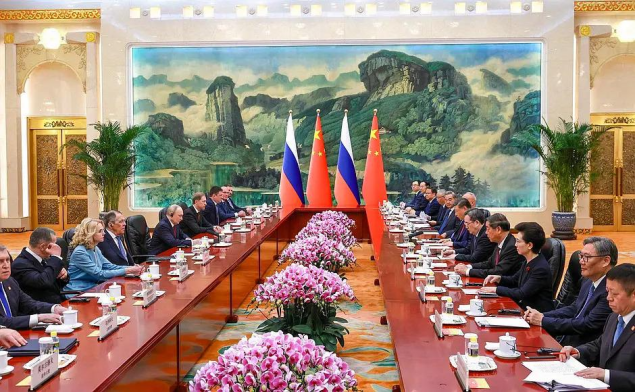
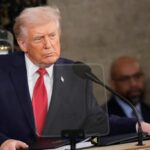
Without naming Washington directly, Xi criticised “unilateral and hegemonic countercurrents” in global affairs — language widely interpreted as aimed at the United States. Putin, meanwhile, described Russia-China coordination as a “key stabilising factor” during a tense period in international politics.The optics also contrasted sharply with Trump’s visit, which ended without any major trade breakthrough or Chinese support on key international issues. In comparison, Xi and Putin signed more than 40 agreements and extended their 2001 friendship treaty, reinforcing the image of an increasingly institutionalised partnership.
Energy partnership remains the backbone of ties
Energy once again dominated the discussions between Beijing and Moscow. Since Russia’s invasion of Ukraine in 2022 and the imposition of sweeping Western sanctions, China has become Moscow’s most important economic partner and the largest buyer of Russian oil and gas.Putin described energy cooperation as the “locomotive” of bilateral economic ties, insisting that Russia would remain a reliable supplier despite growing instability in the Middle East. Russian officials said oil exports to China rose sharply during the first quarter of 2026, with bilateral trade reaching roughly $228 billion last year.For Xi, energy security remains critical as tensions in the Gulf threaten global supply chains. The Chinese leader called for a “complete cessation of hostilities” in the Middle East, warning that prolonged conflict could disrupt industrial supply networks and international trade.Beyond oil and gas, both sides also pledged deeper cooperation in artificial intelligence, digital infrastructure and advanced technologies. Russia’s state-backed firms are increasingly looking towards Chinese hardware and semiconductor support as Western sanctions continue to restrict access to critical technology.
No major breakthrough on Power of Siberia 2
Russian deputy Prime Minister Alexander Novak said on Wednesday that Russia and China were now finalising contracts for gas supplies through the prospective pipeline, according to state news agency TASS. His remarks came after Russian President Vladimir Putin held talks with Chinese President Xi Jinping in Beijing.The proposed project would transport 50 billion cubic metres of Russian gas annually to China through Mongolia and help Moscow replace lost European markets following the Ukraine war.Kremlin spokesman Dmitry Peskov said the two sides had reached a “basic understanding” on the route and construction plans for the pipeline, though he admitted that no timetable had been finalised and several details still remained unresolved.Putin had earlier suggested that “practically all key issues” had been resolved before the trip, raising expectations that a breakthrough agreement could emerge during the summit. Instead, the discussions underlined both the progress and the remaining limits of the partnership, even as Moscow and Beijing continued to publicly project close strategic ties.
Shared positions on Ukraine and global security
The two leaders also used the summit to present a broadly unified position on major global conflicts, especially Ukraine. In a joint statement, China and Russia said the war required addressing its “root causes” and backed efforts to find a solution through dialogue and negotiations.China has consistently avoided condemning Russia’s military campaign while portraying itself as neutral. Beijing has also maintained trade ties with Moscow and continued supplying dual-use technologies that Western governments say help sustain Russia’s defence sector.Russia openly welcomed China’s position, praising Beijing’s “objective and unbiased” approach towards the conflict. The summit reinforced how closely aligned the two countries remain diplomatically, despite pressure from the West.The leaders also criticised what they described as attempts by certain countries to dominate global affairs in a “colonial” manner. In their joint declaration, both sides warned the world risked descending into the “law of the jungle” if existing security frameworks collapsed.
Growing opposition to US-led security policies
A major focus of the summit was opposition to American strategic and military policies. Russia and China jointly criticised Trump’s proposed Golden Dome missile defence initiative, arguing that it threatened global strategic stability and risked triggering a new arms race.The two countries also accused Washington of failing to pursue meaningful nuclear arms control negotiations after the expiry of key Cold War-era agreements. Their joint statement called for greater adherence to international law and the principles of the United Nations Charter.For both Xi and Putin, the partnership increasingly serves a wider geopolitical purpose beyond economics. Moscow sees Beijing as essential to offsetting Western isolation, while China benefits from having a powerful strategic partner willing to challenge US influence globally.